Types of Locks in Escape Rooms: The Complete Guide
22 de October de 2026
If you’ve ever been inside an escape room, you know there’s a magical moment: that instant when the lock finally gives way with a satisfying click. Behind that small victory lies a fascinating world of mechanisms, logic and design. Knowing the types of locks you’ll come across will help you tackle each challenge with more confidence and enjoy the experience even more. In this guide, technical but light-hearted, we look at how each one works and what to expect from them.
If you’re still new to this world, we recommend starting with our guide on what an escape room is to understand the general mechanics of these games. Once you’ve mastered the basics, locks will stop being a mystery and become your best allies.
Why Locks Are the Heart of an Escape Room
Locks are the bridge between solving a puzzle and moving forward in the story. Each one acts as a physical validation: if the answer is correct, the mechanism opens and the adventure continues. This tangible confirmation delivers a rush of satisfaction that no screen can match.
Designers also use locks to control the pace of the game. A four-digit numeric lock offers 10,000 possible combinations, which makes trial and error impossible without losing precious time. That’s why puzzles always give you the key in a logical way, and there’s no need to force anything. If you’d like to learn more about this creative process, discover the secrets of escape room builders.
The Main Types of Locks You’ll Find
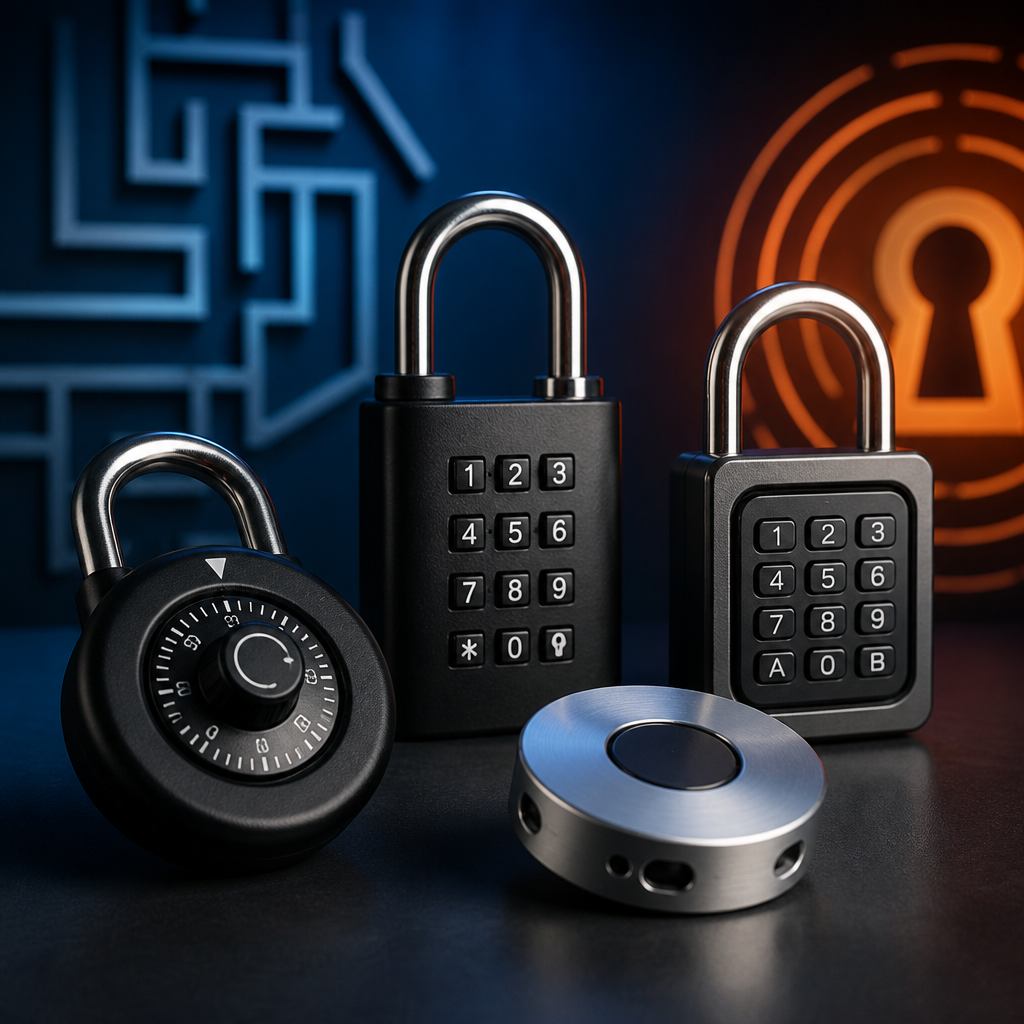
Although every room has its own personality, there are four families of locks that appear again and again. Getting to know them will give you an immediate advantage when interpreting the clues in your surroundings.
1. Directional Locks
These locks don’t use numbers, but movements: up, down, left and right. They are operated with a small lever or a disc that moves in different directions, and the combination is usually a sequence of arrows, such as “up, up, right, down.” They are highly valued because they allow the key to be hidden in the form of drawings, maps or routes.
Think of a visual clue like a maze drawn on a piece of paper or a pattern of footprints on the floor. By translating that route into movements, you get the exact sequence. It’s an ideal type of lock for introducing spatial logic into the game.
2. Numeric Locks
These are the most classic and recognizable: wheels with digits from 0 to 9 that are aligned to form a code. The most common ones have three or four wheels, although some models have up to five. Their great advantage is versatility, since any puzzle that produces a number can be connected to them.
The clues leading to a numeric lock are usually calculations, dates, quantities of objects or coordinates. A useful tip: always write down the numbers you find, even if you don’t yet know what they are for. Often, a piece of data that seemed irrelevant in the first room turns out to be the key to the last one.
3. Alphanumeric and Letter Locks
These mechanisms replace or combine numbers with letters, which multiplies the complexity. A letter wheel with 26 positions and four wheels generates more than 450,000 combinations. This makes it possible to hide keywords, character names or themed terms such as “MAGO” or “RUNA.”
The associated puzzles are usually anagrams, substitution ciphers or cryptograms. This is where teams with a good eye for language shine. If the lock requires a word, look for textual clues, inscriptions or codes that follow an alphabetical logic.
4. Magnetic and Electronic Locks
Here we enter the most spectacular territory. Magnetic locks open when you bring a magnet or a specific object close to them, while electronic ones are activated by sensors, keypads or sequences of switches. They are behind those moments when a bookshelf slides open or a secret door is revealed.
Since there is no visible combination, the key is interaction: placing the right object in the right spot or completing a circuit. They are the favorites of sci-fi and fantasy rooms, where technology or magic justifies the effect. You can see this for yourself in adventures like Dimensión Paralela, where the futuristic setting calls for out-of-the-ordinary mechanisms.
How to Approach Each Lock: Practical Tips
Rather than “lock-picking tricks” to force them open, what really works is method. An escape room is a logic game, and the key is always in the environment itself. These tips will help you open locks effectively and without frustration:
- Count the wheels or positions on the lock before looking for clues: it tells you how many digits or letters you need.
- Gather all the numeric and text clues in one place to spot patterns.
- Try logic before force: you never need to pull or force a mechanism.
- Say out loud what you find, since another teammate may connect it to a different lock.
- If a code doesn’t work, check whether you’ve read the clue in the right order or whether an intermediate step is missing.
- Ask the game master for a hint when you’ve been stuck for a good while; it’s part of the game.
Common Mistakes When Opening Locks as a Group
One of the most frequent mistakes is hogging the lock: one person tries combinations while everyone else watches. The ideal is to split up the roles, so that some look for clues and others verify them. This dynamic is especially valuable at corporate events, where collaboration makes the difference.
Another common mistake is forgetting the context. If you’re in a horror room, such as Las Brujas, the code may be hidden in a ritual or an unsettling object. And if you’re exploring magic in the Harry Potter-inspired room, spells and runes may hide the combination you’re looking for. Always look beyond the lock.
Summary: Master the Locks and Enjoy the Game More
Knowing the different types of locks transforms the way you play. Directional locks reward spatial logic, numeric ones mathematical deduction, alphanumeric ones linguistic ingenuity, and magnetic ones interaction with the environment. Each follows a different logic, but they all share one goal: to make you feel clever when they open.
Now that you know their anatomy, it’s time to put it into practice. Explore our catalog of escape room games, choose your adventure and show your team how well you can open locks. And if you’re looking for something different, you can give the experience as a gift with our escaPark gift cards.