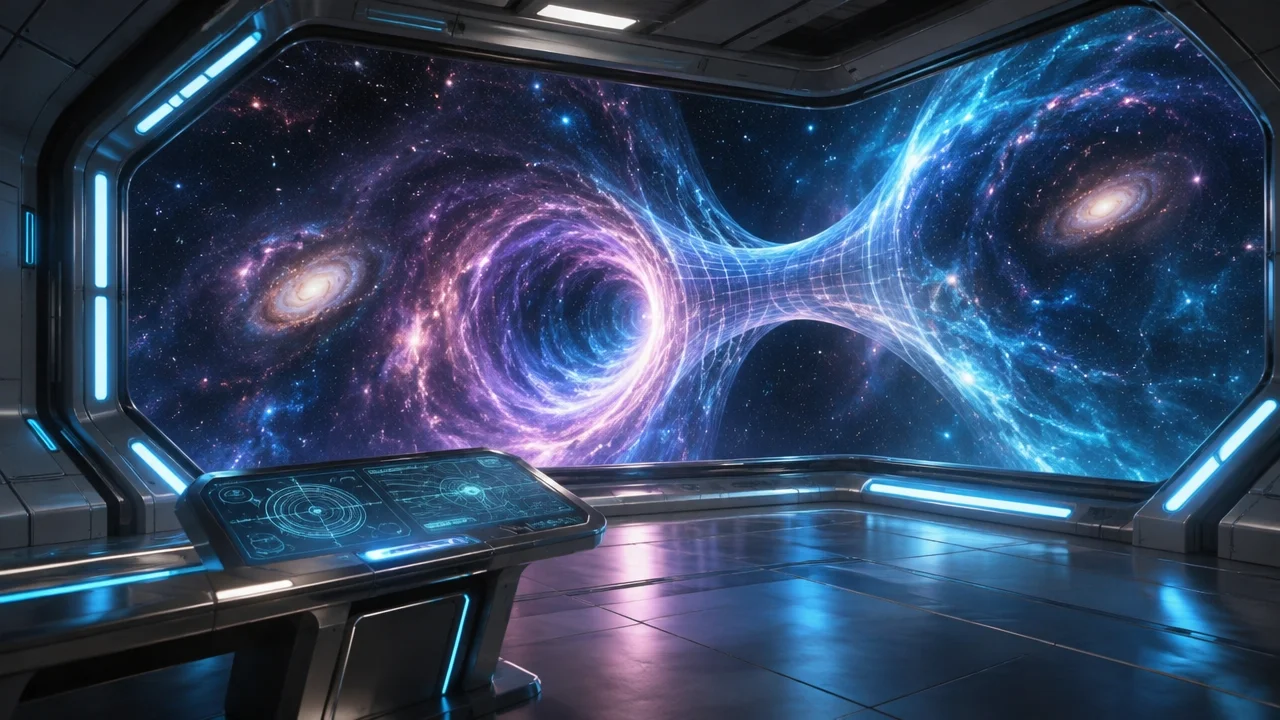
Alternate Universes: Decoding the Parallel Dimension
24 de November de 2026
Imagine stepping into a room where the laws of physics stop working and every object hides a clue from another universe. That is exactly what a parallel dimension turned into an escape room offers: a science fiction adventure where everyday logic gets twisted and ingenuity becomes your best tool. In this article we explore what makes this type of experience special, how its futuristic puzzles work and which strategies will help you escape in time. If you are looking for something different to do with friends, family or your work team, keep reading.
What is a parallel dimension and why is it so fascinating?
The concept of alternate universes has fuelled literature, cinema and theoretical physics for decades. The idea that realities exist running parallel to our own, with small or enormous differences, sparks an almost universal curiosity. TV series, films and video games have popularised notions such as the multiverse, time travel and spacetime anomalies. An escape room is the ideal format to stop watching it from the sofa and live it first-hand.
In the Parallel Dimension room at escaPark, your team faces an anomaly that has torn the fabric of reality. Your mission is to navigate this altered space, understand its new rules and escape before time runs out. The sci-fi atmosphere, with futuristic technology and striking sets, immerses players from the very first second.
Wormholes and altered logic: the heart of the challenge
One of the great appeals of a science fiction room is that it can play with ideas that would be impossible in the real world. Wormholes, for example, are theoretical shortcuts between two distant points in spacetime. In an escape room, that idea translates into mechanisms that connect seemingly unrelated elements, so that a clue found in one corner may only make sense when combined with something at the other end of the room.
When the usual rules no longer apply
The so-called altered logic is the star of the show. What in a traditional escape room would be a linear sequence can here be reversed, repeated or work in counterintuitive ways. Players must question their assumptions and try approaches they would normally dismiss. This mental flexibility is precisely what makes the experience so stimulating.
To go deeper into this way of reasoning, we recommend reading our article on divergent thinking as the key to the Parallel Dimension. There we explain why the best solutions often appear when you leave the obvious path behind.
Futuristic puzzles: what to expect
Futuristic puzzles combine classic escape room elements with an aesthetic and mechanics typical of science fiction. You do not need to be an engineer or a physics expert to solve them: everything is designed so that any group can progress through observation, communication and creativity. Even so, it helps to know the most common types of challenges so you arrive prepared.
- Codes and ciphers: messages from another reality that must be decoded by comparing symbols and patterns.
- Sequence puzzles: panels and mechanisms that require activating elements in a specific order.
- Observation challenges: hidden details in the environment that only make sense when seen from a different perspective.
- Logic riddles: problems in which the rules change and you must deduce how this new universe works.
- Simultaneous teamwork: tests that require several players to act at the same time from different points.
The key is that no challenge depends on prior technical knowledge. It is all about thinking, trying, making mistakes and trying again, always with the clock ticking. That controlled tension is what turns every game into a small space mission.
Tips for escaping the parallel dimension
Although every group experiences the room in its own way, some habits make the difference between finishing with seconds to spare and falling just short. Applying them from the start will help you organise better and enjoy the process more. These are the most effective ones we recommend to the teams that visit us.
- Say everything you find out loud, however insignificant it may seem.
- Split tasks according to everyone’s strengths: observation, calculation, handling or reading.
- Don’t get stuck on a single puzzle; if something isn’t progressing, change approach or change person.
- Stay organised: set aside clues you have already used so you don’t get confused.
- Ask for help when you need it; hints are part of the experience.
Ideal for groups, families and company teams
This type of room works especially well for those looking for more than a bit of fun. Groups of friends enjoy the shared adrenaline, families find a challenge that brings different ages together, and corporate teams get a genuine team-building dynamic. In an environment where nobody knows the solution beforehand, hierarchy disappears and everyone contributes.
If you are not sure what to expect, our guide What is an escape room? answers the most common questions from first-timers. And if you would like to compare options, you can explore the full catalogue of escape room games to choose the challenge that best suits your group.
Conclusion: dare to cross to the other side
The parallel dimension is much more than an escape room: it is an invitation to think differently, collaborate under pressure and enjoy a science fiction story in which you are the protagonist. Between wormholes, altered logic and futuristic puzzles, every minute counts and every decision matters. It is a perfect experience for celebrating, bringing teams together or simply breaking out of your routine.
Ready to break the rules of reality? Book your adventure in the Parallel Dimension and find out whether your team can escape before time runs out. And if you want to surprise someone special, check out our escape room gift cards.